Which specific part of Schneier’s argument is the most persuasive? Why?
I found the information provided on other forms of identification astounding. Explaining how heartbeat and gait are used to identify people from a distance was effective in getting his point across. Along with the tracking of IP and MAC addresses, credit cards, license plates, phone numbers, and more, identification technology is impossible to escape from.
Which part(s)do you find least persuasive? Why?
Although the knowledge of alternative identification technology is informative, I wish the author went into more detail about them. Providing examples or cases of when and how these tracking systems are used. This would have made his argument more credible.
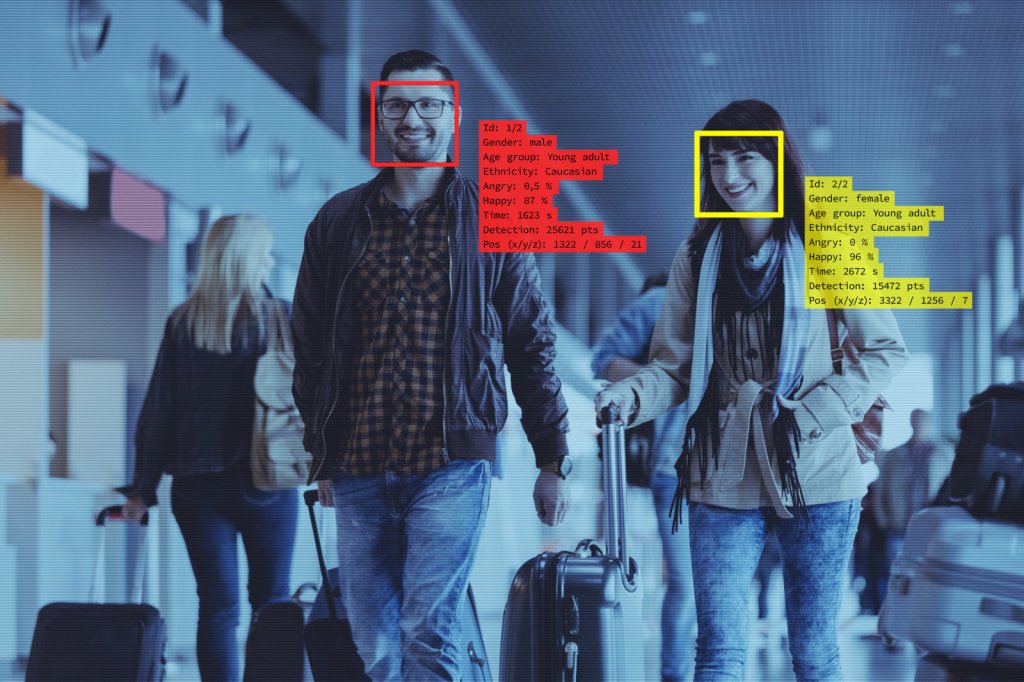
Facial Recognition System at the Airport. People carrying luggage.
Based on the case details in this article, in what ways has the use of facial recognition by Florida law enforcement shown promising success?
In a 2017 armed robbery case, facial recognition was used to identify a suspect. Surveillance footage was shown to the suspect’s girlfriend, who confirmed it was him. In 20 separate cases, facial recognition was able to help identify individuals who could not identify themselves, including murder victims and Alzheimer patients.
What are some concerns that it raises?
One concern that facial recognition software in police cases raises is accuracy. There is plenty of room for error when dealing with digital software to identify human beings. Reports have shown that there are more false positive reports when evaluating images of black women. Another concern is privacy. Some people feel that facial recognition is intrusive or breeches some form of trust with the government and law enforcement.
Do you think universities should use facial recognition systems?
I personally do not think facial recognition should be used in universities. Perhaps if I was in a situation where my safety was at risk I would feel differently, but I think privacy is more important and outweighs the benefits of facial recognition systems.
In what industries will robots replace human workers? How should workers and their families and communities handle this transition, especially if they are over the age of 50 or so?
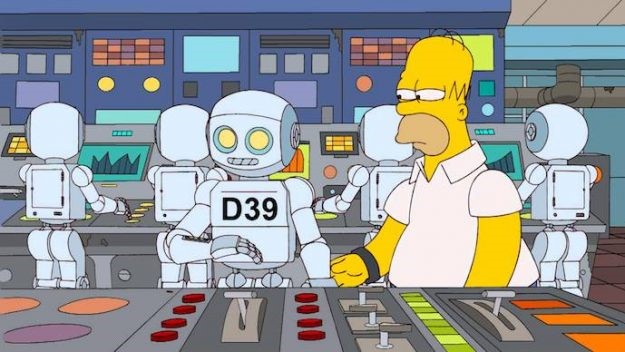
With advances in technology, many jobs have and will continue to become obsolete. ATMs and online banking have already replaced bank tellers. Companies like Amazon and online shopping can quite possibly replace physical stores, which already use self checkout systems instead of cashiers. Netflix ad online streaming services have put stores like Blockbuster out of business and movie theaters are often empty nowadays. From factory workers, to clerks, to even teachers, technology is dominating industries where real people were once needed.
Although the demand for less skilled labor is decreasing, the demand for skilled digital labor is increasing. Graphic designers, engineers, and programmers are all becoming more necessary in the digital age. Although younger generations are drawn to tech, this labor shift puts older people at risk of unemployment. My advice would be to take classes on digital literacy and immerse yourself in technology as much as possible to become comfortable with computer programs and systems that are being widely used.
The chances of two people feeling a special attraction and an interpersonal spark (i.e. “chemistry”), are comparatively greater in a digital environment than offline. Do you agree or disagree, and why?
In a digital environment, it is easier to feel “chemistry” with others than it is offline, despite physical barriers. In fact, the lack of physical intimacy and immediate response is a large part in why it is so easy to feel attraction online. Sociologist Mary Chayko believes online relationships are more “durable” due to an emphasis on shared interests and character qualities rather than physical qualities.
As deeper connections form, we tend to project onto one another. Chayko says it is common to project onto individuals the qualities we want them to have. The “absence of visual cues” enhances this process and accelerates the progression of a relationship. In other words, we create an image of someone and fall in love with the idea of them, rather than who they really are. We do this both online and offline, but in a digital environment, people have the ability to shape themselves into something that they are not. People have the ability to edit aspects of themselves to appear how they would like to be perceived, further enforcing the characteristic we project onto them.
In a way, dating online is like stepping into a virtual reality. The chemistry can be too good to be true. It’s important to remember that what we see online is only one face of a three dimensional thing.
In the age of social media, nothing is entirely authentic. We as people tend to put on a face for others. Even around our closest friends we act differently, as certain people bring out certain qualities in us. When we remove face-to-face interaction, we distance ourselves even further from our truest identities. We filter ourselves, usually in favor of a better image. We generally post images where we look attractive or are having fun. We post about the new jobs we get or the vacations we take. We refrain from posting that we’ve recently been fired or that we’ve sat in bed binge eating all day. On social media, we make our lives appear as interesting as possible.
Although technology has the ability to bring people together, it has a tendency to do the opposite. Due to naturally occurring social stratification, there is a digital divide, separating those in the digital world and those who are not. Technology access and digital literacy both play a part in this divide. The separation is caused by things like geographic location, socioeconomic status, age, and more. People in third world countries and areas of lower income often don’t have the resources to stay connected online or to even understand how the tech we use on a daily basis works. According to Superconnected, in turn, “when the rate of internet penetration is low, the abilities of these citizens and their countries to benefit in a global economy is reduced” (Chayko, p.97). It becomes a catch-22; internet access and technology development are imperative to economic growth. Without these things, it is difficult to improve the quality of life. Things like education, employment, and access to healthcare are all affected.
In today’s society, it’s hard to identify real news from “fake.” With platforms like Facebook, Youtube, and the ability to create your own website, it’s easier than ever to build a false news outlet. Misinformation is often shared on Twitter and Fakebook. Even trusted news outlets share false stories by accident. One way to tell if information on a website is real is to check credibility. This includes researching citations and the authors of articles (if there are no sources cited, something might be fishy). To combat this, sites like Facebook have employed “human fact-checkers” to make sure bots are not spreading false information on their platforms. As “citizen journalists,” it is also our duty to assess the validity of the information we consume before sharing it with others.
One of the advantages of portable technology is accessibility. Endless information is at our fingertips at all times. With the development of smartphones, we are able to access databases, take pictures, research, take notes, and so much more. Another advantage is the ability to stay connected, both with each other and with the world. With social media and text messaging, it is incredibly easy to contact friends and family and see what others are up to. We receive news updates moments after events occur, there is no need to wait for the daily paper to be printed and sent out.
In addition to these advantages, there are some drawbacks. One of which is increased laziness. When a world of information is in the palm of our hand at all times, we tend to take advantage of this and don’t bother learning new skills, simple math, or definitions. Another disadvantage is that portable technology can easily become a distraction. Hundreds of thousands of video games are available in app stores, ready to be played at any moment. On top of that, social media platforms like Snapchat, Instagram, and Tiktok are intentionally designed to suck you in.




 Digital Culture